
Collaborative learning can strengthen addiction counselor training by giving students opportunities to discuss clinical concepts, practice communication skills, consider different perspectives, and receive constructive feedback. For students pursuing addiction counseling credentials in Colorado, these experiences can complement the formal coursework required for Certified Addiction Technician (CAT), Certified Addiction Specialist (CAS), and Licensed Addiction Counselor (LAC) pathways. Collaborative learning supports skill development, but it does not replace Colorado’s credentialing, examination, education, or supervised-experience requirements.
What Does Addiction Counselor Training Mean in Colorado?
If you are searching for certified addiction counselor training in Colorado, it is important to understand the state’s current terminology. Older websites, documents, and search results may still use the abbreviation “CAC” or refer to Certified Addiction Counselor credentials. Colorado’s current individual addiction counselor credentials are:
- CAT – Certified Addiction Technician
- CAS – Certified Addiction Specialist
- LAC – Licensed Addiction Counselor
The Colorado Department of Regulatory Agencies (DORA) State Board of Addiction Counselor Examiners is responsible for issuing these credentials to applicants who satisfy the applicable statutory and regulatory requirements.
Current Colorado regulations require nine individual courses or trainings for the CAT educational pathway. For CAS, the regulations specify 20 total courses or trainings, including the nine CAT trainings. For LAC, the regulations specify seven individual addiction counseling courses or trainings in addition to other applicable statutory requirements.
Coursework is only one part of credentialing. Education, supervised experience, examinations, application requirements, and other criteria may also apply depending on the credential being pursued. Students should review current state requirements before deciding which courses they need.
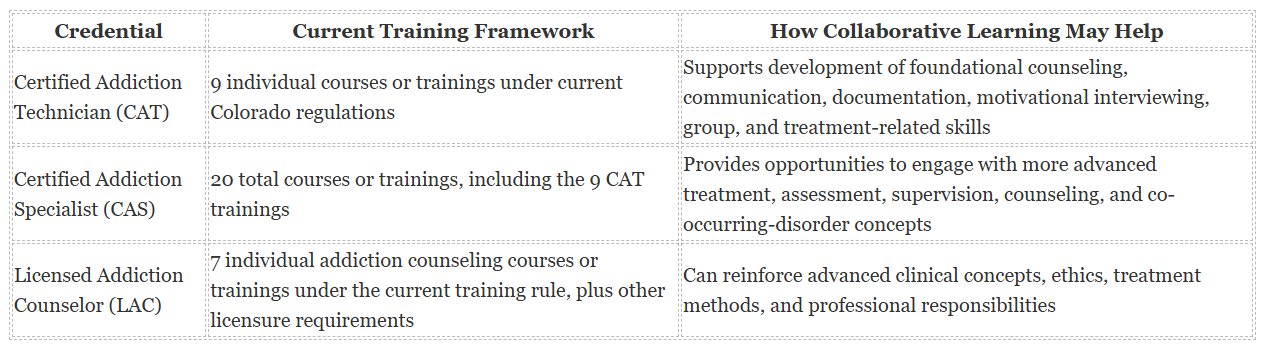
Colorado Counselor Training organizes its current addiction counselor training courses around the CAT, CAS, and LAC pathways.
Why Does Collaborative Learning Matter in Addiction Counselor Training?
Addiction counseling requires more than memorizing definitions or treatment models. Counselors need to communicate effectively, listen carefully, evaluate information, maintain professional boundaries, respond ethically, and work with clients whose experiences and perspectives may differ significantly from their own.
Collaborative learning can help students move from understanding a concept intellectually to considering how that concept might be communicated or applied in a professional setting.
That does not mean every counseling course needs to involve group work. Course formats and learning objectives vary. Some material can be effectively studied independently, while skills-focused topics may benefit more from discussion, practice, instructor feedback, or live interaction.
The goal is not collaboration for its own sake. The value comes from using interaction to strengthen understanding and develop skills connected to the subject being studied.
How Can Interacting With Peers Strengthen Counselor Training?
Peer Discussion Can Introduce Different Perspectives
Addiction counselors may work with people from different cultural backgrounds, communities, age groups, family structures, and life experiences. A student approaching a case scenario from one perspective may interpret it differently from another student.
Discussing those differences can encourage students to question assumptions, explain their reasoning, and consider information they may initially have overlooked. This is especially relevant in counselor training programs where cultural awareness, client-centered communication, and ethical decision-making are important parts of professional development.
Peer perspectives should not replace course material, professional standards, or instructor guidance. Instead, they can provide another way for students to examine how they understand and communicate what they are learning.
Skills Practice Can Make Counseling Concepts More Concrete
Some counseling techniques are difficult to fully understand from reading alone. Active listening, asking open-ended questions, responding to resistance, facilitating groups, reflecting client statements, and using motivational interviewing techniques all involve interpersonal communication.
Colorado Counselor Training’s current CAT courses include skills-oriented topics such as Addiction Counseling Skills, Group Counseling Skills, and Motivational Interviewing. Current course descriptions indicate that certain classes incorporate experiential training, live interaction, videotaping, or feedback.
Practicing a skill gives students an opportunity to experience how their communication may be received by another person. Feedback can then help them identify what was effective and what may need refinement.
Explaining a Concept Can Reveal Gaps in Understanding
Students sometimes feel that they understand a subject until they try to explain it clearly to someone else. Discussing topics such as treatment planning, documentation, ethical responsibilities, motivational interviewing, or counseling theories can reveal areas where additional study is necessary.
This type of interaction can turn passive familiarity into more active understanding. It can also help students formulate better questions for instructors when a concept remains unclear.
Students Can Build a Professional Learning Community
Addiction counselor training may bring together people who are new to behavioral health as well as those already working in treatment programs, community organizations, or related fields.
Connecting with classmates can make it easier to discuss course challenges, exchange professional perspectives, and become familiar with others working toward similar goals. These relationships may become useful professional connections, although participation in a training program does not guarantee employment, referrals, advancement, or other career outcomes.
Why Is Instructor Interaction Important?
Peer discussion can be valuable, but instructor guidance serves a different purpose. Instructors can connect questions and practice activities to the competencies being taught, clarify misunderstandings, and provide structured feedback.
This becomes particularly important when a subject involves professional judgment. A student may understand the definition of a counseling technique but still need help recognizing when it is appropriate, how it should be communicated, or why one response may be more effective than another.
Colorado Counselor Training’s published course descriptions show that feedback is incorporated into certain skills-focused classes. For example, Motivational Interviewing includes videotaping and feedback to support skill development, while clinical supervision coursework addresses observation, coaching, and feedback.
Students can make these interactions more productive by asking specific questions. Instead of simply asking whether an exercise was “right,” they can ask what could be improved, how the response relates to a particular counseling competency, or what alternative approaches should be considered.
How Does Collaborative Learning Connect to Professional Counseling Skills?
Collaborative learning is not a credential requirement by itself. Its value lies in helping students engage more actively with subjects that are relevant to addiction counseling practice.
For example:
- Case discussions can encourage students to distinguish observed facts from assumptions.
- Role-playing exercises can help students practice communication and counseling techniques.
- Documentation exercises can illustrate the difference between vague statements and clear clinical information.
- Group activities can provide experience with communication, participation, boundaries, and facilitation.
- Instructor feedback can help students connect their performance to the competencies being taught.
- Peer feedback can show students how their communication may be interpreted by another person.
These educational activities should not be confused with clinically supervised professional experience. Classroom practice, peer discussion, and training exercises do not replace supervised work experience or other requirements established for a Colorado credential.
What Is the Difference Between CAT, CAS, and LAC Training?
The three credential pathways represent different levels within Colorado’s addiction counseling credentialing structure.
Certified Addiction Technician (CAT)
CAT is a Colorado certification with nine required individual courses or trainings under the current state training framework. Students researching this pathway can review Colorado Counselor Training’s CAT course options to see the subjects currently offered.
Certified Addiction Specialist (CAS)
CAS requires a broader training framework. Current regulations specify 20 total courses or trainings, including the nine CAT trainings. In practical terms, students who have completed the required CAT training continue into additional CAS-level subjects. Colorado Counselor Training provides a dedicated CAS course section for these additional courses.
Licensed Addiction Counselor (LAC)
LAC is a licensed credential rather than a certification. Current Colorado rules specify seven individual addiction counseling courses or trainings as part of the LAC pathway, but coursework alone is not sufficient for licensure. Applicants must satisfy the other applicable statutory and regulatory requirements. Students can review current LAC course options and compare them with Colorado’s current licensing requirements.
How Should You Choose the Right Addiction Counselor Training Courses?
Start with the credential you intend to pursue rather than registering for courses based only on a general search for counseling certifications.
- Identify your intended credential. Determine whether you are working toward CAT, CAS, or LAC.
- Check current Colorado requirements. Review the latest credentialing rules and application requirements from the appropriate Colorado agencies.
- Compare your previous education and training. Do not assume that every student needs exactly the same starting point.
- Review course prerequisites. Some advanced courses may require completion of earlier skills-based training.
- Consider the course format. Determine whether the course is self-paced, online, live virtual, or includes scheduled interactive components.
- Ask questions before registering. If you are uncertain whether a particular course fits your credential path, clarify that before enrollment.
This approach helps students focus on the training that is relevant to their actual credentialing goals rather than relying on outdated CAC terminology or older course lists.
Frequently Asked Questions About Addiction Counselor Training in Colorado
Does Colorado still use the CAC credential?
Colorado’s current individual addiction counselor credentials are CAT, CAS, and LAC. You may still encounter “CAC” terminology in older documents, legacy web content, or general search phrases such as certified addiction counselor training. Students should rely on current CAT, CAS, and LAC requirements when planning their credential pathway.
What does CAT stand for in Colorado?
CAT stands for Certified Addiction Technician. Current Colorado regulations require nine individual courses or trainings as part of the CAT educational pathway. Coursework is not necessarily the only credentialing requirement, so students should review current state requirements before applying for certification.
What does CAS stand for in Colorado?
CAS stands for Certified Addiction Specialist. Under current Colorado regulations, the CAS training requirement consists of 20 total courses or trainings, including the nine CAT trainings. Students progressing from CAT-level training therefore complete additional CAS-level coursework rather than starting an entirely separate 20-course sequence.
What does LAC stand for in Colorado?
LAC stands for Licensed Addiction Counselor. It is a licensed credential. Current Colorado rules include seven individual addiction counseling courses or trainings for the LAC pathway, along with other statutory and regulatory requirements. Completing those seven courses alone does not automatically qualify someone for licensure.
Does completing addiction counselor training make me certified?
No. Completing required training does not by itself mean that a student is certified or licensed. Depending on the credential, Colorado may have additional education, examination, supervised-experience, application, and other requirements. Credentialing decisions are made by the appropriate state authority, not by the training provider.
Are Colorado Counselor Training courses available online?
Yes, many current course listings use online or virtual formats. However, the format varies by course. Some skills-focused classes include scheduled virtual sessions, experiential exercises, videotaping, or feedback, while others are offered online without the same interactive components. Review the individual course description before registering.
Can classroom practice replace clinical supervision?
No. Classroom discussion, role-playing, peer feedback, and instructor feedback are educational activities. They do not replace clinically supervised work experience or formal supervision required under an applicable credential pathway. Students should treat course training and supervised professional experience as separate parts of the credentialing process.
Where should I start if I am unsure which courses I need?
Begin by reviewing Colorado’s current CAT, CAS, and LAC requirements and then compare those requirements with your education and previously completed training. You can also review Colorado Counselor Training’s counselor training courses and ask about available classes before registering.
Build Counseling Skills Through Active Learning
Strong addiction counselor training combines accurate course content with opportunities to think critically about how counseling concepts apply in practice. Peer discussion, skills exercises, and instructor feedback can make that process more active by helping students test their understanding, practice communication, and identify areas that require additional development.
For Colorado students, the first step is understanding the correct credential pathway. CAT, CAS, and LAC are the current credentials to focus on, even if older content or search results still use CAC terminology.
Colorado Counselor Training offers coursework for individuals pursuing Colorado addiction counselor credential pathways. To review available training options, visit the counselor training program. For questions about current courses, schedules, or registration, call 970-567-0938 or contact Colorado Counselor Training.